
A week lived in words
Others' and mine

I’ve had to put myself ‘out there’, as the term goes, quite a bit of late, thanks to the book launch. I’m constantly searching for ways to promote one’s book without being an insufferable jackass who puts out humble-brag posts on LinkedIn, but as the song goes, I still haven’t found what I’m looking for.
Pretty certain I’ll have no friends left by the end of this journey, who would have all been sacrificed at the altar of Amazon reviews and Good Reads ratings. When I’m sitting at the very top of every conceivable bestseller list possible, when I’ve won the holy trinity of Pulitzer-Booker-Women’s Prize, when I’m to be found pontificating on the stages of Hay-Edinburg-Jaipur, do ask me if it was all worth it, and I will lean against a backlit door like a shawl-wrapped, unshaven Guru Dutt and proclaim Yeh duniya agar mil bhi jaaye toh kya hai.
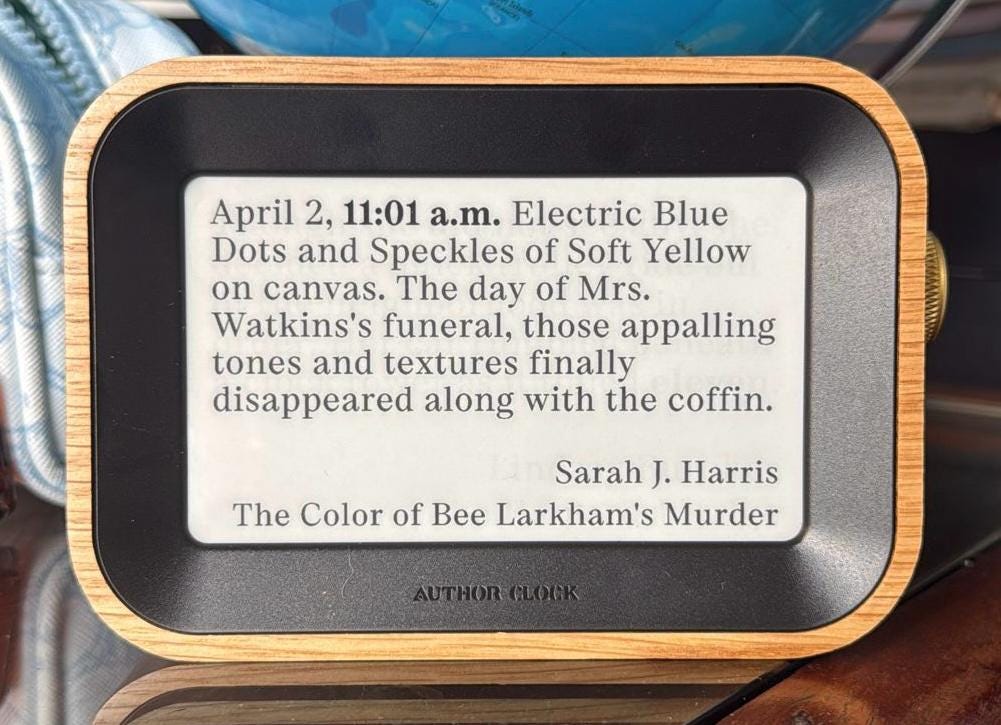
Impressed by my ability to be obnoxious over sustained periods of time, my husband bought me a gift. It’s a clock, except that it tells time in literary quotes at vague times. It’s 11:01 right now and so -
I have also been burying and burrowing myself in books, as I always do when the real world, and my own place in it, becomes too much. For one, I read Pale Fire. Now, I have known Nabokov’s writing in the way most people do, which is to say I’d read only Lolita till now, and have been astounded by his craft, and disturbed by the underlying psyche. But Pale Fire is another matter altogether. It’s inaccessible in the way castles in fantasy novels are, protected by deep moats and unscalable walls and monstrous beings at the gates, but it is also absolutely unputdownable. You are never lost in this book, in fact you are, at all times, acutely conscious of being in the presence of genius. Wah, huzoor, wah, I genuflect to the sometimes cancelled and always absent Nabokov at the end, and wonder why do I even bother to write at all. The woods would be silent etc, I console myself and move on.
And what do we have here but the short and lingering The Prime of Miss Jean Brodie by Muriel Spark (originally published by The New Yorker in 1961). It has that quality that some novels have, of leaving behind something, like a wave retreating into the ocean. And years later, the memory of some stray phrase from it makes itself felt.
Now on to Mohd Hanif’s Rebel English Academy.
**
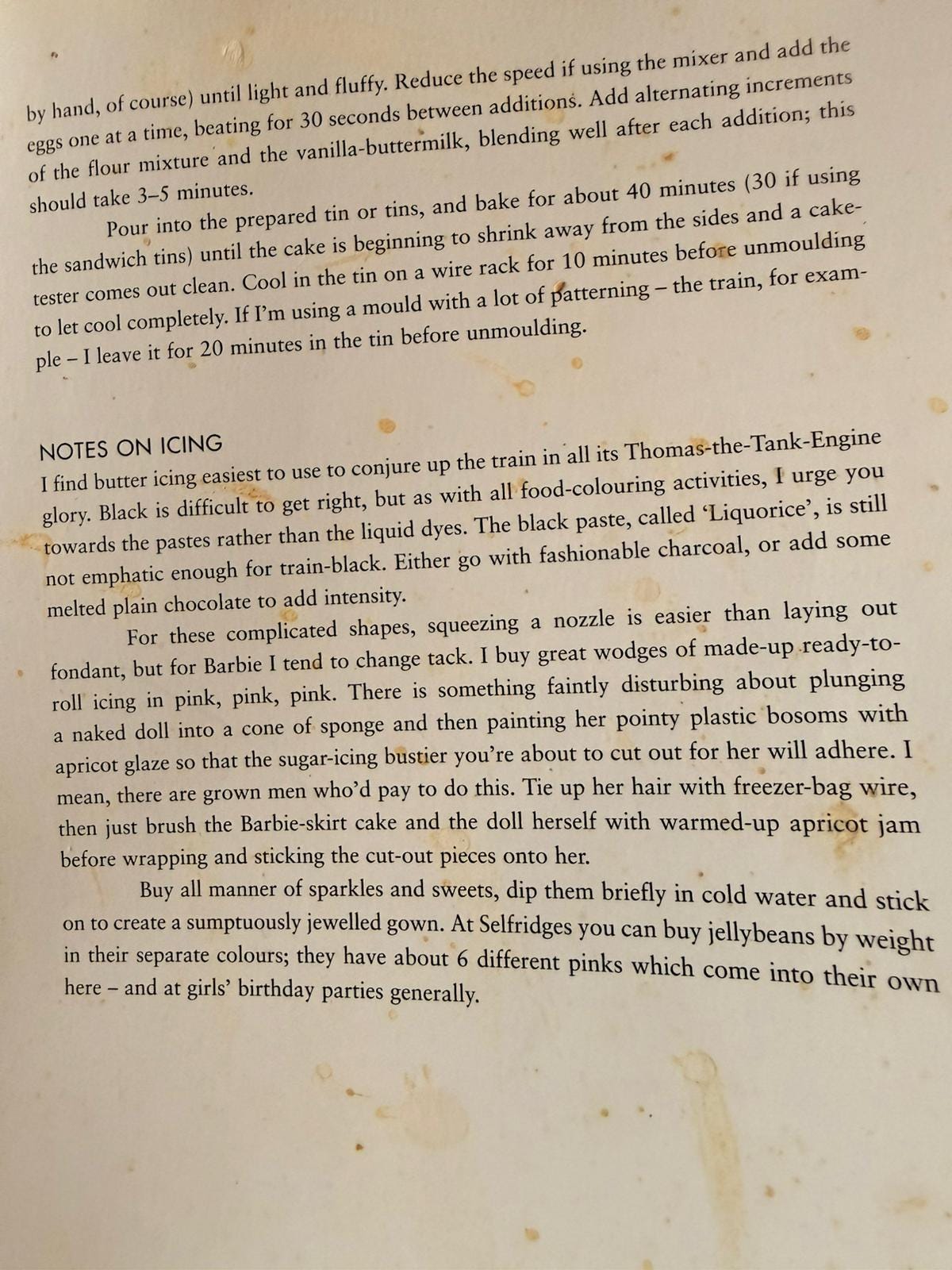
My children have their birthdays this week, and I am nostalgically looking at the Buttermilk Birthday Cake recipe in Nigella Lawson’s How To Be A Domestic Goddess. The pages are splattered with batter stains, remnants of birthdays past and as I look at the words standing resolutely behind the drops of flour and butter frozen in time, I am struck once again by the words of Lawson. What a gifted writer. Take this, for example –
**
There is no escaping AI, is there? Anywhere I turn, people are predicting the annihilation of writing as we knew it because a chatbot will do it faster, cheaper and without getting drunk. I worry about it, because honestly even perfectly good writers are using it and you can see how the edges are washing away, how everything is deviating to the mean, how everyone is sounding the same. I admit I am at that age when I cannot tell Alia Bhatt apart from Kiara Advani, or indeed from a standing floor-lamp, but even so, I’d like to stay relevant for a few more years, if that’s not too much to ask for. As always, Maria Popova of The Marginalian came to my rescue in these moments of doubt –
I once asked ChatGPT to write a poem about a total solar eclipse in the style of Walt Whitman. It returned a dozen couplets of cliches that touched nothing, changed nothing in me. The AI had the whole of the English language at its disposal — a lexicon surely manyfold the poet’s — and yet Whitman could conjure up cosmoses of feeling with a single line, could sculpt from the commonest words an image so dazzlingly original it stops you up short, spins you around, leaves the path of your thought transformed.
An AI may never be able to write a great poem — a truly original poem — because a poem is made not of language but of experience, and the defining aspect of human experience is the constant collision between our wishes and reality, the sharp violation of our expectations, the demolition of our plans.
Ain’t that the truth, mon ami? I think we need to really worry about writing when AI gets sentient. Till the time we are flawed, damaged, heart-broken in the way only humans can be, perhaps our jobs, vocations and gifts are safe.
And on that note, have you bought a copy of my latest book?
Where can one buy that Author Clock?