
Of Linking Road
Archived essay about the road that I still think about

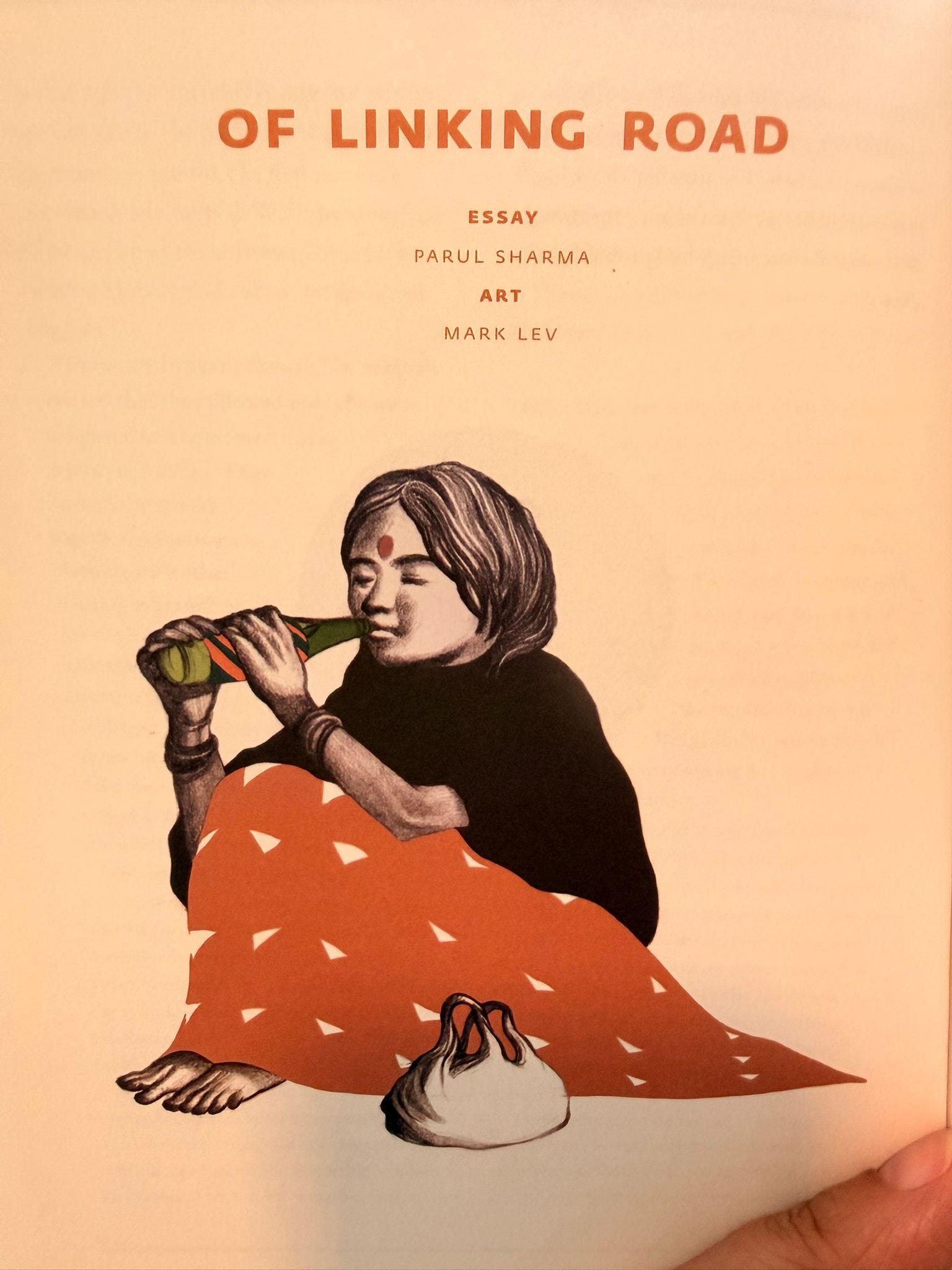
Many years ago, I wrote this essay about Linking Road, the road in Bombay that has at least as many contradictions as potholes. It originally appeared in Annalemma, an American literary arts journal.
I was reminded of it given our recent discussion on the criticality of place in fiction. How does one make it come alive, what is the role of mahaul in fiction, and how do we begin to truly observe.
I was preoccupied by this road, and it made me anxious. I felt compelled to write about it. Parhiye.
**
The streets of Mumbai are not for you, who gets scared easy. Nor you, the one with the queasy stomach. Not this street, not my street. Some say it is a high street with showrooms jostling with local shops struggling with makeshift stalls. It is expensive, this land and shops shut down all the time, their signs replaced almost overnight by more hope. It is also a low street, home to the homeless family that I have seen expand over these past few years, the children growing rapidly on food that they scrounge from the temple nearby. There is religiosity here. Some of it is misplaced.
Girls wear shorts here, their legs exposed to the heavy Mumbai sun that never lets up for things as trivial as winters. They go into the stalls, bargaining like the famous fishwives of the fishing village nearby, emerging triumphant with bags of cheap trends that will go out before too long. These girls go to good colleges in the neighbourhood. Some of them will be asked to change their first names when they get married and they will feel empowered in having to choose from the shortlist presented to them. Identities are sold short here. Not enough fight back.
There is heat here. Heat from the sun and from the motors that have baked in the sun all day long. Tempers are frayed like well-worn nerves. There is too much, too many of everything here. Too many cars, too many auto-rickshaws, too many buses, too much smoke, too much dust, too much atmosphere.
Helmets hang by the handlebars, to be put hastily on when a policeman comes into sight. A painfully thin boy, always in a too-tight black t-shirt and matching black pants, walks by. He wears some make-up, mascara, that t-shirt is from the women’s section, his hair is streaked in fashion colours. He is familiar and unusual. Some people stare at him. He has friends in the branded sneaker store nearby. They call out to him. He waves back but keeps walking. Some of his friends laugh. There is tolerance here. It doesn’t seem to be enough.
There are potholes here and manhole covers often go missing. Pedestrians take care to avoid those but don’t complain. Not too much. There is cow-dung, the same cow-dung sold as mosquito repellent cakes at the Farmer’s Market each Sunday. This is no place for a poet. Or perhaps, just the place. The air smells impure, heavy, like profanities were just uttered here. You have to wait for the sun to set because when the night falls, the strings of fairy lights lining the shop-windows are lit and for a moment this tired street breathes in the air coming in from the sea, holding the promise of a better world. There is prettiness here. It is fleeting, momentary.
It reeks of money. It is fragrant with money, this street of mine. There are alleys breaking away from the street, leading inside into the labyrinth of a Mumbai suburb. There are old cottages here that belong to Catholic families that have lived here for generations. There are apartments costing half a million dollars. There are old churches and bakeries that sell macaroons. There are popular actors here and failed models and nuns and women in old-fashioned skirt-suits and unknown writers and stockbrokers. There are health clubs here and gymnasiums and yoga classes taught by Caucasians who drone out an accented Om. A lot of people are fleshy here. Obese and unwell, they make their reluctant way into the promise of fitness, of control.
Restaurants abound here and food from the world is available, tasting a bit different, a lot different. The vegetables on the carts look too shiny, the brinjals suspect. People are eating everywhere, at sandwich stalls, at the pani-puri wallah, at the ice-cream parlour, at the cafes and invariably there is a group of beggars at the fringe, asking, demanding to be fed too. The beggars on this street are not forsaken creatures. They are confident in their misery, in their mud-caked clothes, trying to talk the college students into parting with a few rupees or a soft drink, their choice. There is plenty here. It’s not for all.
The streetlights don’t go off here. It’s not a small Indian town after all but a few years ago, it was almost the end of the world when this city flooded, its plastic-blocked drainpipes unable to take the deluge of the rain and the incoming tide. I saw whole cars submerged in water and there was no bread to be found anywhere. No bread and no milk. People walked the whole night to get to their homes, soaked wet, holding hands to form human-chains, guided by the street-dwellers to steer clear of the open manholes. In that moment, there was empathy here. It came through in the moment of need.
We cringe at the stereotypes of cows crossing our street although it is true that they do. Their owners tie some of these cows to an electric pole next to the street and women in beautiful clothes keep coming in luxury cars to feed these animals. They bow down to the cows, their eyes closed in prayer, hoping that the gentle jugaali will see them through their misfortunes. There is trust here. A lot of it is blind.
People keep coming to the car windows, keep tapping at the panes, willing you to hear them, to look at what is in their hands – a bundle of glossies, piles of pirated books, newspapers, boxes of strawberries, flimsy plastic toys. To look at them is to see the plea in their eyes. You are standing between us and the beggars asking to be fed. To see them is to unmask your daily dilemmas of right and wrong. Questions of morality are rampant here. They last till the traffic light turns green.
Bandra to Borivali, it’s a long street and it sees different worlds as it goes on its way. It gets harder as it winds north, though, the people keep getting more tired, wearier of the jostling, shoving. Sometimes it catches a sight of the ocean but there is no time to stop and look. There is a funny-looking airplane stuck in a park. Later, much later there are malls to be seen, bigger than ever because land is cheaper here but the people who can afford the wares have all been left way behind.
What do all these people feel about this street, I often wonder. Are they intimidated by how much it sees in each, a street-smart cousin that often makes you tongue-tied? Or is it just affection for its strange ways, its idiosyncrasies, an old aunt with a colourful past?
This is my street, a crazy street. It is not for all. It likes to scare, to drive away but also to lure, to entice. There are lies here. And truth. All of it.
**
Read like a poem. Even though you say it is no place for a poet, or just the place. Reminded me of Sandra Cisneros’ “You bring out the Mexican in me”, which many years ago had inspired me to write “You bring out the Dilliwali in me”. Places are ❤️